
The Race To Space
January 31, 1958 - The first successful launch of an American satellite.
On this day in 1958, President Eisenhower received a telephone call shortly after 10:48 in the morning on his direct line to Cape Canaveral, Florida. The President was informed that the launch of the Explorer I satellite had been successful!
The U.S Army's Explorer program launched the first successful American satellite into orbit - the Explorer I. The Army's previously scrapped satellite program was revived as a crash program to catch up with the Soviet Union after the launch of Sputnik I four months earlier on October 4, 1957.
Two months earlier the first U.S. attempt to launch a satellite had failed. This time, the Army Ballistic Missile Agency's research team worked in conjunction with the Jet Propulsion Laboratory in California to produce a modified Jupiter-C rocket that could carry Explorer I. Explorer I was put into orbit around the earth by a Jupiter-C rocket. Radio signals from the transmitter aboard the 30.8 pound satellite were picked up in California within a few minutes after the launch. Explorer I would orbit the earth in about 114 minutes at an altitude of altitude between 230 to 2,000 miles above the earth.
The success of Explorer I would initiate decisions that lead to the formation of the National Aeronautics and Space Administration - NASA - in July of 1958. The race to space was on!
Besides being the first U.S. satellite, Explorer I is known for discovering the Van Allen radiation belt. Since 1958 NASA has launched a series of "Explorer" spacecraft to conduct a wide variety of scientific investigations.
Quote for ToDay:
"Everything we do ought to really be tied in to getting on to the Moon ahead of the Russians...otherwise we shouldn't be spending that kind of money, because I'm not interested in space... The only justification is because we hope to beat the Soviet Union to demonstrate that instead of being behind by a couple of years, by God, we passed them!" - President Kennedy to NASA's director James E. Webb


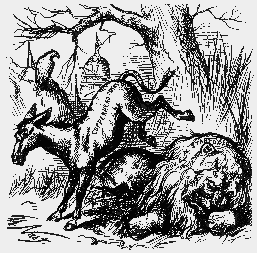 The "A Live Jackass Kicking a Dead Lion" cartoon used the jackass to symbolize the Democratic Party for the first time. Thomas Nast first used the jackass in his January 15, 1870 Harper's Weekly cartoon to represent the "Copperhead Press" of northern Confederate sympathizers kicking a dead lion, the lion symbolizing Lincoln's Secretary of War Edwin M.Stanton, who had recently died. Nast intended the jackass to represent the Democrat leaning Copperhead anti-war faction, with whom he disagreed, but the symbol caught the public's fancy and the cartoonist continued using it to indicate Democratic editors and newspapers.
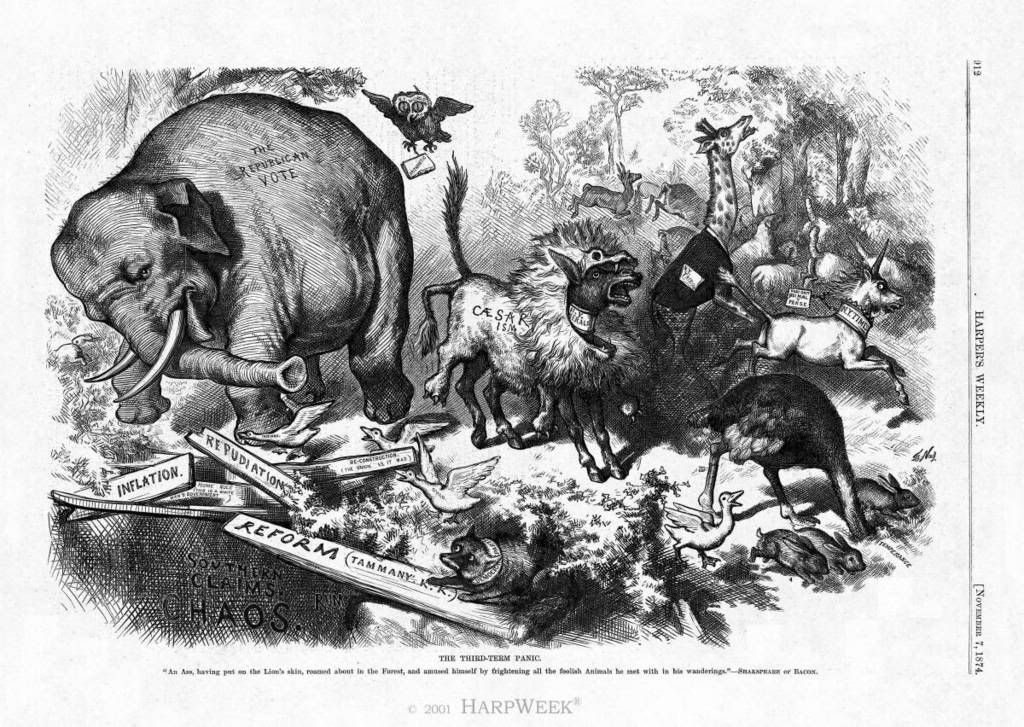 Nast would portray the Republican party as Elephants in a 1874 Harper's Weekly illustration. Nast's depictions of the two major political parties are still prominently displayed and recognized more than a century later. Over the years, the jackass and the elephant have become the accepted symbols of the Democratic and Republican parties. Although the Democrats have never officially adopted thejackass as a party symbol, they have used various jackass designs on their publications over the years. The Republicans have actually adopted the elephantas their official symbol.
 The circus, one of America's favorite family pastimes, dates back nearly 250 years. On this day in 1768, the first incarnation of the modern-day circus debuted. English equestrian Philip Astley had first snared the public's attention by riding horses standing up and realized quickly that there was money to be made in death-defying stunts.
 indoors with the construction of the amphitheatre to house his groundbreaking show.


